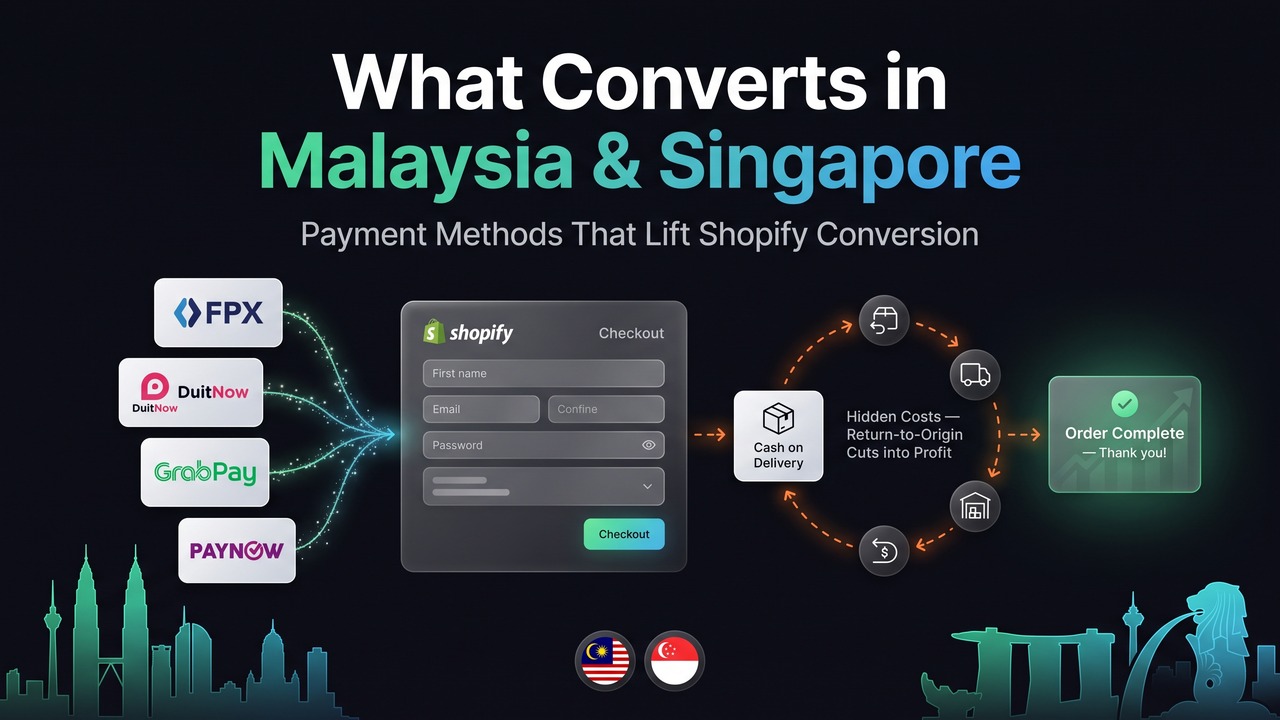
Yes, for domestic Malaysian and Singaporean buyers, adding local payment methods almost always lifts checkout completion versus a card-only flow, because cards are a minority of how these markets actually pay. In Malaysia, alternative methods (FPX, DuitNow and e-wallets) make up roughly two-thirds of ecommerce transactions; in Singapore, wallets and PayNow together outweigh cards. FPX, DuitNow, PayNow and GrabPay are near-certain wins to add. Cash on delivery (COD) is the exception: it lifts orders placed but carries a return-to-origin cost that can wipe out the gain, so it needs a margin decision, not a default toggle.
Why does the payment method affect conversion at all?
The payment step is where a shopper decides whether they trust you enough to hand over money, using an instrument they are comfortable with. Three things move the needle. First, friction: entering a card number, expiry and CVV on a phone is clumsier than approving a payment inside a banking or wallet app already open. Second, trust: being redirected to your own bank's portal, or paying inside GrabPay, feels safer than typing card details into a brand you bought from for the first time. Third, authorisation success: bank-authenticated transfers like FPX are drawn straight from the account, so they decline far less often than cards hitting credit limits or risk rules.
Two terms worth defining up front, because global CRO blogs rarely use them. A2A (account-to-account) is a real-time bank transfer straight from the buyer's account, the rail behind FPX, DuitNow and PayNow. RTO (return-to-origin) is a shipped order that never gets delivered and comes back to you, the core problem with COD.
What are the main local payment methods in Malaysia and Singapore?
Six matter for a Shopify store in these markets:
- FPX (Malaysia): real-time bank transfer via online banking, connecting 20-plus banks. Per-transaction limit around MYR 30,000, lower fees than cards, fewer declines. No native recurring billing.
- DuitNow (Malaysia): bank transfer and QR payments, deeply familiar from everyday retail and P2P. Supports full and partial refunds. No recurring or one-click.
- GrabPay and Touch 'n Go (Malaysia): the leading e-wallets. GrabPay holds about 38% of the Malaysian wallet market; Touch 'n Go has roughly 20 million verified users. Fast, mobile-first, loyalty-driven.
- PayNow (Singapore): real-time transfer on the FAST network, backed by the Association of Banks in Singapore, paid by mobile number, NRIC or QR. Low cost, instant, and preferred by 68% of Singaporean Gen Z.
- Mobile wallets (Singapore): GrabPay, DBS PayLah! and card-token wallets like Apple Pay and Google Pay. Together the leading online payment mode in 2025.
- COD: pay cash when the parcel arrives. Reverses payment risk for the buyer, which is exactly why it converts and exactly why it is expensive.
The table below maps each to who uses it and what it does to checkout completion.
| Method | Market | Mechanism | Best-fit buyer | Recurring | Merchant cost | Effect on checkout completion |
|---|---|---|---|---|---|---|
| FPX | Malaysia | Real-time bank transfer | Domestic, bank-centric, higher-ticket | No | Lower than cards | Strong uplift vs card-only |
| DuitNow | Malaysia | Bank transfer + QR | Domestic, mobile-first | No | Low to moderate | Strong uplift, high local trust |
| GrabPay / TNG | Malaysia | E-wallet | Younger, mobile-first | Limited | Moderate | Moderate to strong uplift |
| PayNow | Singapore | A2A via FAST (mobile/NRIC/QR) | Domestic, mobile-first, all tickets | Not native | Low | Strong uplift vs card-only |
| Mobile wallets | Singapore | Wallet apps, often FAST-linked | Everyday, younger | Varies | Moderate | Strong uplift (dominant share) |
| Cards | Both | Credit / debit | Cross-border, high-ticket | Yes | Higher | Baseline, needed for some segments |
| COD | Both | Cash on delivery | Cash-reliant, trust-sensitive | No | Operationally high | Lifts orders placed, net effect unclear |
Which payment methods should you add for Malaysian buyers?
Lead with FPX and DuitNow, add at least one wallet (GrabPay or Touch 'n Go), and keep cards for cross-border and card-centric shoppers. The reasoning is straightforward: if alternative methods are around two-thirds of Malaysian ecommerce, with A2A near 39% and wallets near 24%, then a card-only checkout is actively fighting the way most of your buyers want to pay. FPX and e-wallets together clear over 65% of digital transactions, and 64% of Malaysians used QR payments in 2024.
The one caveat is subscriptions. FPX and DuitNow do not support recurring billing or saved one-click payments, so if your model is replenishment or membership, keep a card or wallet as the recurring backbone and offer the local rails for one-off purchases. For most one-off DTC categories (fashion, beauty, electronics, FMCG), FPX plus DuitNow plus a wallet covers the bulk of domestic preference.
Which payment methods should you add for Singapore buyers?
Lead with PayNow and mobile wallets, keep cards for high-ticket and cross-border. Cards still hold the largest single share of Singapore ecommerce value at around 44%, but mobile wallets reached about 45% of B2C ecommerce transactions in 2025 and PayNow sits at the centre of that ecosystem. Ignoring PayNow and wallets means ignoring roughly half of how Singaporeans pay online, and a disproportionate share of the mobile-first and younger buyers you are usually trying to win.
PayNow is cheap, instant and trusted because it runs inside the buyer's own banking app. For higher-value orders, keep cards available so buyers who want credit lines or chargeback protection have them. The mix, not the single method, is what maximises conversion.
Does cash on delivery (COD) increase conversion, and is it worth it?
COD reliably increases orders placed, because it removes the buyer's payment risk entirely. For cash-reliant or trust-sensitive segments it can be the only way to convert them at all. But orders placed is not the number that pays your bills. What matters is profitably delivered orders, and COD leaks badly there.
What does a failed COD order actually cost?
Every COD order that fails to deliver comes back to you as an RTO, and you pay for the round trip. Reported COD RTO rates in Southeast Asia vary widely by source, country, category and how well orders are screened: one regional logistics source puts SEA COD RTO around 8% to 15%, while others cite 15% to 30% and higher for unscreened, low-value or fashion traffic. Prepaid orders sit at a fraction of that, typically low single digits, because payment is confirmed before you ship. Treat the exact figure as something to measure in your own data, not a benchmark to assume.
The cost of one failed COD order stacks up fast. A worked Shopee Malaysia example puts it at RM8 outbound shipping, RM2.50 failed-delivery fee, RM12 return shipping and RM3.50 reprocessing, so RM26 per failed order. At a 20% failure rate that is roughly RM5.20 of extra cost spread across every COD order you take, before you count lost margin on the sale that never happened. On top of that, Malaysian couriers add a COD surcharge of RM2 to RM7 per parcel even when the order delivers successfully.
The maths that decides it is simple. Profit per shipped COD order is roughly the delivery success rate times (gross margin minus outbound shipping), minus the failure rate times the return cost. If margins are thin and RTO is high, COD can lose money on delivered orders even while your top-line order count looks great. Run that number before you switch it on.
When COD still makes sense
COD earns its place when the incremental profit from buyers you could not otherwise win beats the RTO and handling cost. To make that likely, de-risk it:
- Verify high-risk orders by WhatsApp or phone before dispatch (new customers, high value, odd addresses).
- Set tiered COD limits, with a lower cap for first-time buyers and a higher one after a clean delivery history.
- Nudge COD to prepaid with a small incentive, for example 5% off or free shipping for paying by FPX, DuitNow or PayNow.
- Turn COD off for known problem postcodes, repeat refusers and low-margin SKUs.
- Automate the flagging with rules in Shopify, GTM or n8n rather than checking orders by hand.
How do you add local payment methods on Shopify?
The build is straightforward once the gateway is chosen:
- Enable a gateway that carries the methods you need. Shopify Payments covers cards and some local methods; Stripe, Adyen and Checkout.com add FPX, PayNow, DuitNow and wallets depending on market.
- Activate each method in your Shopify Payments settings. Note that local methods display based on the customer's location, not your store's, so a Singapore buyer sees PayNow whether or not you are based there.
- Set currency correctly in Shopify Markets, so Malaysian buyers see MYR and Singaporean buyers see SGD, matching the amount debited.
- Be aware Shopify requires around 100 processed orders on Shopify Payments before some local methods can be switched on.
- Order the checkout so the dominant local method appears first for each market, with cards kept available underneath.
If you want this scoped and built without breaking an existing theme or gateway, that is exactly the kind of work our Shopify implementation team handles.
How do you know it actually worked?
Do not assume, measure. Track checkout completion rate by payment method before and after you add the local rails, and for COD track net delivered orders and RTO by method, not just orders placed. If a method is not pulling its weight or COD is quietly losing money, the data will say so. Building that measurement into your checkout is part of how we approach conversion rate optimisation: the change only counts if the numbers move.
Frequently Asked Questions
Will adding FPX and DuitNow increase my Shopify conversion rate?
For domestic Malaysian buyers, almost certainly yes. Together with e-wallets they represent the majority of how Malaysians pay online, so a card-only checkout leaves orders on the table. The main exception is subscription billing, which FPX and DuitNow do not support, so keep a card or wallet for recurring charges.
Should I offer cash on delivery on my Shopify store in Malaysia?
Only after you run the RTO and margin maths. COD reliably lifts orders placed, but return-to-origin rates in the region can run anywhere from about 8% to 30% depending on your screening, and each failed order carries round-trip shipping plus fees. On thin margins it can lose money per delivered order even while order counts rise.
Does PayNow improve checkout conversion in Singapore?
Yes for domestic Singapore buyers, especially mobile-first and younger shoppers. It is low cost, instant, and runs inside banking apps people already trust, which removes friction and hesitation at the payment step.
Do I still need to accept credit cards?
Yes. Cards remain important for cross-border buyers, high-ticket purchases where credit lines and chargeback rights matter, and card-centric segments. Local methods complement cards, they do not replace them.
How many payment methods should I show at checkout?
Enough to cover the dominant local preferences, and no more. Piling on obscure options adds decision friction. For Malaysia that is usually FPX, DuitNow, a wallet and cards; for Singapore, PayNow, a wallet and cards.
Start with the buyers you already have
Payment localisation is one of the few conversion fixes that is a one-time build with a permanent payoff. You are not buying more traffic, you are stopping the traffic you already pay for from bouncing at the last step because the method they wanted was missing. Add FPX, DuitNow, PayNow and a wallet, then decide COD on the maths, not the hype. If you want a read on where your checkout is leaking, talk to us.