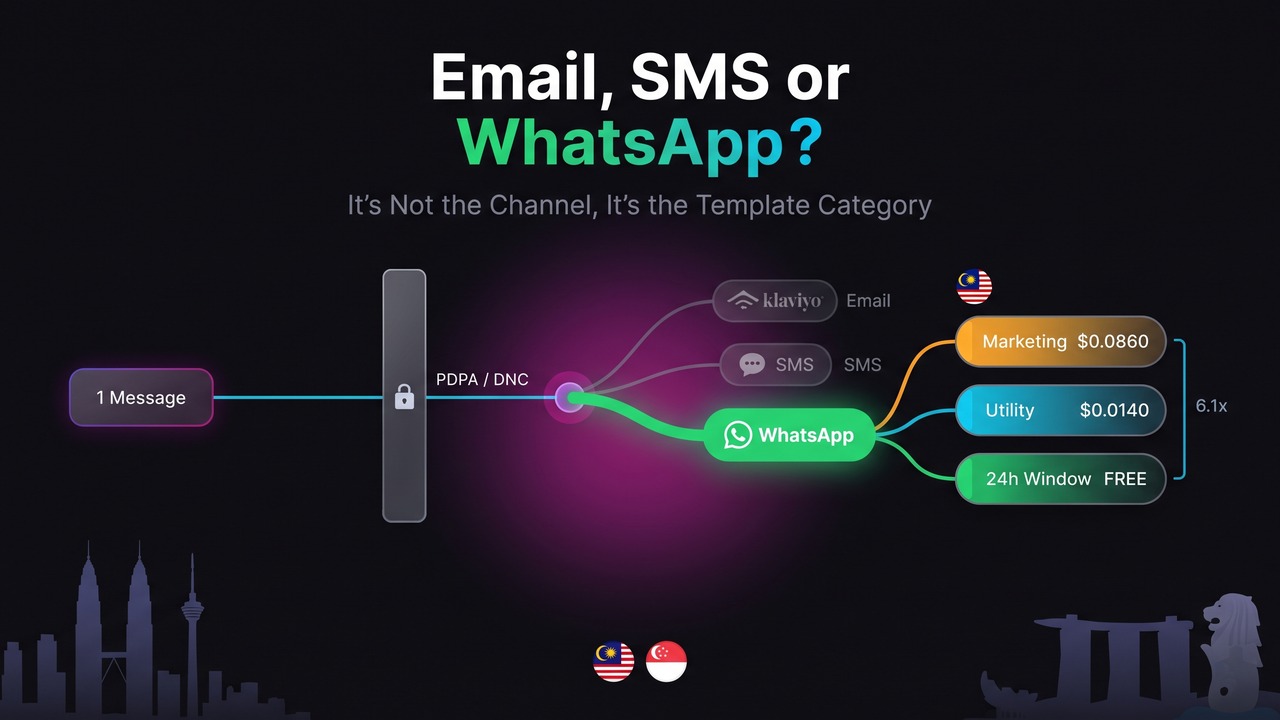
For ecommerce retention in Southeast Asia, run all three and choose per message, not per brand. Email carries anything long, cheap or non-urgent. WhatsApp carries order updates, service replies and a few high-intent promotions. SMS carries time-critical alerts on a verified mobile number. What actually moves your cost is not the channel, it is the WhatsApp template category, the label Meta requires on every template, which sets its price. On Meta's rate card effective 1 July 2026, a marketing template to a Malaysian number costs USD 0.0860 against USD 0.0140 for a utility template, and a utility template sent inside an open customer service window costs nothing.
Which channel should carry which retention message?
Assign each channel the job it is priced for.
| Channel | Job | Cost model | Consent basis | Use when |
|---|---|---|---|---|
| Newsletters, education, win-back, weekly sends | Fixed, on list size | Personal Data Protection Act (PDPA) consent and notice | Default. No deadline, no per-send fee | |
| SMS | OTPs, delivery-day alerts, payment failures | Per message, varies by route | PDPA, plus a Do Not Call (DNC) Registry check for SG numbers | No WhatsApp opt-in on file |
| Order updates, service replies, high-intent promotions | Per delivered template, by category and country | PDPA, DNC, plus Meta's opt-in policy | Needs a reply, image or button |
The working rule: if a message is not worth a per-message fee, it is an email. Flow structure barely changes across channels, so if you are still building the sequences underneath, the flow-by-flow build for Singapore and Malaysia brands covers those.
What does WhatsApp actually cost in Malaysia and Singapore?
Meta moved off conversation-based pricing on 1 July 2025. You are charged per delivered template, priced by category and recipient country code. Volume tiers exist only for utility and authentication templates (one-time passcodes), so marketing never discounts.
| Market | Marketing | Utility / auth |
|---|---|---|
| Malaysia | USD 0.0860 (MYR 0.3467) | USD 0.0140 (MYR 0.0564) |
| Singapore | USD 0.0732 (SGD 0.0937) | USD 0.0160 (SGD 0.0205) |
Marketing costs 6.1x utility in Malaysia and 4.6x in Singapore. That gap, not the channel choice, is where the money sits. These are Meta's rates, not your invoice: whoever sends the message prices a markup on top, so treat the table as your floor.
Against SMS the comparison depends on your route, so get a local quote before accepting anyone's cost slide, ours included. Twilio's published international rate to Malaysia is USD 0.3389 and USD 0.0591 to Singapore. Those are international-route prices, not domestic A2P pricing, which runs cheaper in Malaysia, so the ranking can flip there. Meta changes rates only on the first day of a quarter, and service messages become chargeable from 1 October 2026 at the utility rate.
Why does the template category matter more than the channel?
A utility template carries order status and time-sensitive notifications, and Meta's categorisation rules require it to be non-promotional. Mixed content, "for example, both utility and marketing, such as an order update with a promo", counts as marketing. You nominate the category, Meta validates it at review and recategorises utility templates that should have been marketing. Since April 2025 it can do so without the 24-hour notice it previously gave.
Attaching a discount code to a Malaysian order confirmation therefore moves that send from USD 0.0140 to USD 0.0860, and risks recategorisation. Split them:
- Send the order or shipping update as a clean utility template. No offer, no persuasion.
- A customer reply opens a 24-hour customer service window, where utility templates are free today. Build the flow to still work at USD 0.0140, not zero.
- Send promotions as separate marketing templates, to your most engaged segment, not the full list.
Most brands we audit pay the marketing rate for messages that should be utility, because someone added a promo line.
What consent do you need for each channel in Singapore and Malaysia?
Two layers stack: local law, then Meta's policy.
Singapore. The PDPC states directly that DNC Registry rules "apply to specified messages sent to your Singapore telephone number, even on WhatsApp and Telegram", because the app uses the number as its identifier. Its No Text Message Register covers promotional SMS, MMS and app messages to that number. The ongoing-relationship exemption, its examples being a bank or telco, is narrower than most brands read it.
Malaysia. No DNC registry, but the Personal Data Protection (Amendment) Act 2024 phased in across 2025, per Mayer Brown, adding a mandatory data protection officer and breach notification from June 2025 and a rewritten cross-border transfer regime from 1 April 2025. That last one matters because Klaviyo processes your data outside Malaysia.
Meta, on top of both. The WhatsApp Business Messaging Policy requires an opt-in "that encompasses the different categories of messages that you will send", so a blanket marketing tick does not cover order updates or the reverse. A sustained low quality tier also means Meta limits your send volume, making consent quality a deliverability input, not only a legal one.
This is practitioner reading, not legal advice. Treat consent capture and customer data as one build, not two projects.
How do you decide whether WhatsApp is worth the setup?
Meta publishes no per-country WhatsApp user numbers, and DataReportal's Digital 2026 reports for Malaysia and Singapore carry no WhatsApp figure at all. The "90% of Malaysians use WhatsApp" line in a vendor pitch is a vendor estimate, Infobip's, not a measured statistic. So the case for WhatsApp here rests on observed messaging behaviour, not measured demand. That is an inference, so test it against your own numbers:
- Share of support conversations already arriving on WhatsApp.
- Share of checkouts capturing a valid, consented mobile number.
- Share of your email list genuinely engaged, per market.
- Monthly promotional volume per market, times that market's marketing rate.
That last one usually settles it. Four sends a month to a 30,000-contact Malaysian list is 120,000 marketing templates at USD 0.0860, about USD 10,300, against effectively nothing by email. That is the incremental revenue WhatsApp marketing has to beat, which is why it belongs on your best segment while order updates go out on utility.
Testing needs no new tooling: Klaviyo now sends WhatsApp natively and splits by country inside a single flow. It prices WhatsApp per country with its own margin on Meta's rate, and Singapore was absent from its published list in July 2026, so confirm your in-account rate and measure incremental lift, not self-reported clicks.
Frequently Asked Questions
Is WhatsApp cheaper than SMS in Malaysia and Singapore?
It depends on the market and the route. Meta's rate card effective 1 July 2026 puts a Malaysian marketing template at USD 0.0860, against Twilio's published international SMS rate of USD 0.3389. Singapore reverses it: USD 0.0591 for SMS against USD 0.0732 for WhatsApp. Domestic aggregator routes undercut international ones, so quote your own volume.
Do I need separate consent for WhatsApp, SMS and email?
In practice yes. Meta requires an opt-in covering the categories of message you intend to send, and Singapore's PDPC treats promotional WhatsApp to a Singapore number as a specified message under Do Not Call rules. One capture step recording channel, category, timestamp and source works.
Can I include a promotion in a WhatsApp order confirmation?
Technically yes, but Meta categorises mixed utility and marketing content as marketing. In Malaysia that turns a USD 0.0140 send into a USD 0.0860 one and exposes the template to recategorisation. Keep the update and the offer separate.
Take your market's marketing and utility rates above, then audit which WhatsApp templates sit in the wrong one. Shifting even a third of your sends to the utility rate covers the audit, and tells you whether the channel earns its setup. We run this as a Klaviyo Gold Partner for Malaysia and Singapore. Talk to us.