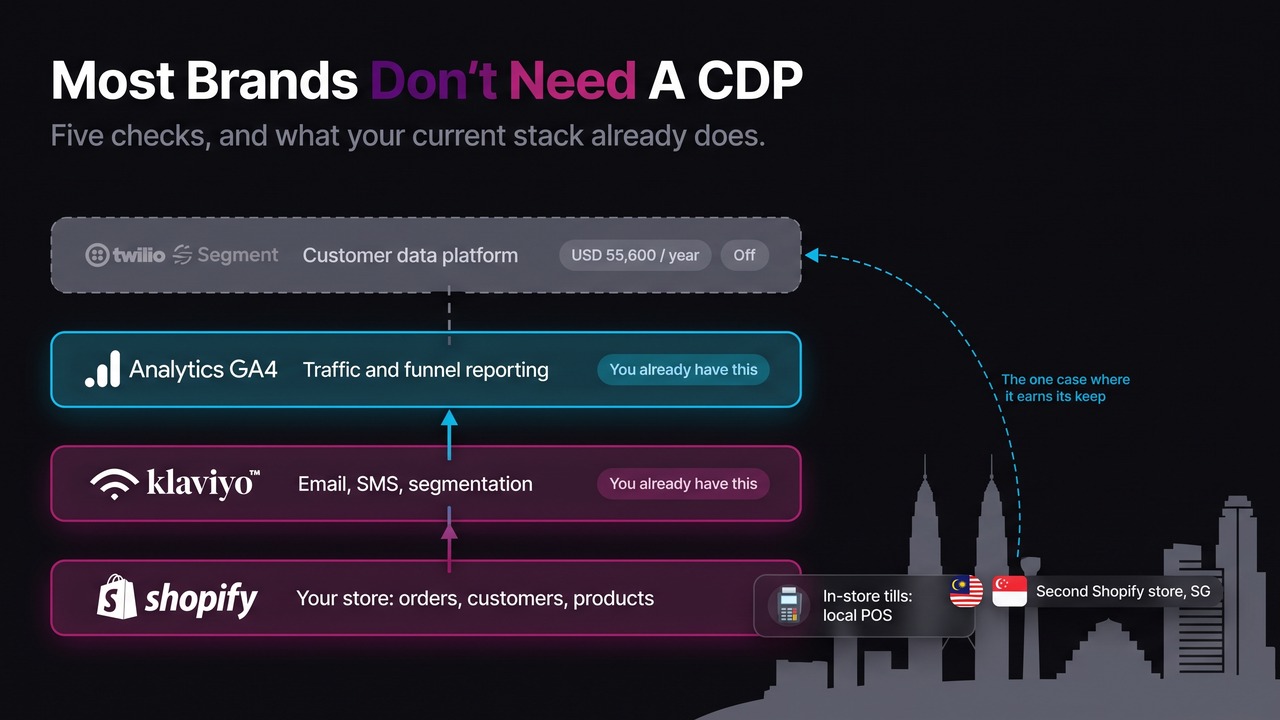
Most Shopify brands do not need a CDP yet, including brands past 100,000 monthly sessions. A customer data platform earns its cost when you have touchpoints that Shopify, Klaviyo and GA4 cannot structurally join into one profile, and someone in-house who owns the data model. If every customer interaction already flows through Shopify, and your segmentation limits are Klaviyo limits you have not hit, a CDP buys a bill and an integration project. Littledata, which sells the cheaper GA4 pipeline it recommends instead, found only 2.5% of Shopify Plus storefronts run a true CDP.
What does a CDP actually do?
A customer data platform does four things: match incoming data points to a single customer profile, build segments from that profile's properties, export those segments to your marketing tools, and keep a permanent record of customer interactions. That is Littledata's definition, with its own caveat: "There's no clear consensus on what a CDP must do to earn the name."
Which is why shortlists mislead. In Littledata's scan, Amplitude (5% of Shopify Plus storefronts) and SnowPlow (3.5%) outranked any real CDP, and neither is one: a tool that cannot resolve identity and push segments back out is a component. That scan under-counts server-side-only setups, so 2.5% is a floor.
When do you not need a CDP yet?
Five checks, against your own stack.
- Every customer touchpoint already lands in Shopify. Shopify unifies POS and online orders, creates profiles at signup, order and abandoned checkout, and segments dynamically. Its own answer: "Not all Shopify merchants need a standalone CDP." Shopify has every interest in keeping you inside its stack, and still says that.
- Your Shopify and GA4 data is still messy. Shopify again: "The wrong time to buy a CDP is when the underlying commerce data is still messy." Test it rather than argue it: do Shopify orders and GA4 purchases reconcile within 5%, and does Klaviyo's placed-order revenue match Shopify's? If not, fix measurement first, because a CDP inherits the problem at a higher price.
- You have not hit Klaviyo's ceiling. If you are not yet using custom profile properties, event-based segments and predictive fields, the constraint is not the platform. Most of the personalisation brands buy a CDP for already sits in Klaviyo, unused. If the gap is flows rather than data, see what actually converts for APAC brands.
- Nobody has half a week, every week, for this. Schema decisions and identity rules need a standing owner. Shopify's split between packaged CDPs for teams with "limited internal data engineering resources" and composable ones for "organizations with a mature data team" is a staffing question wearing a product label, and Littledata's third named cause of CDP failure is no buy-in from the other teams running their own data stacks.
- You cannot name a use case worth USD 4,600 a month. Twilio Segment's published Team rate starts at USD 120 a month for 10,000 monthly tracked users, then USD 10 per extra 1,000, and MTUs count anonymous visitors. At 100,000 sessions, call it 70,000 uniques, which lands near USD 720 a month on published rates (our arithmetic, not a quote) and buys the pipeline only. Vendr's data on 610 Segment purchases puts the median buyer at USD 55,600 a year, six times Team list price once identity resolution and overages are in. Klaviyo's Advanced Data Platform add-on covers warehouse syncing and analytics for USD 500 a month on third-party pricing.
Check 1 alone settles it. Otherwise, three or more true and the answer is no.
CDP vs Klaviyo vs GA4: what is each one actually for?
| Dimension | Standalone CDP | Klaviyo | GA4 |
|---|---|---|---|
| Built for | Joining data across systems | Messaging identified customers | Measuring acquisition and behaviour |
| Identity resolution | Across devices, stores, platforms | Email and phone on known profiles | Cookie and device, plus User-ID |
| Offline and POS data | Any source you pipe in | Only if the POS pushes to it | No |
| Anonymous visitors | Yes, and you pay per visitor | Only once identified | Yes, its core job |
| Holds personal data | Yes | Yes | Not permitted |
| Data lifespan | While you keep paying | Indefinite per profile | 14 months on standard properties |
| Activation | Any connected destination | Email, SMS, WhatsApp, push | Google Ads audiences |
| Typical monthly cost | USD 700 pipeline-only to ~USD 4,600 median | Hundreds to low thousands | Free |
As a Klaviyo Gold Partner in Malaysia and Singapore, we see far more brands underusing Klaviyo's segmentation than outgrowing it. Exhaust the cheap path first: the free GA4 to BigQuery export, plus Klaviyo's own data add-ons.
When should an ecommerce brand implement a CDP? The Malaysia and Singapore case
Littledata names two camps that get real value: brands with dozens of internal tools needing the same data feed, and brands with "lots of non-Shopify customer interactions, maybe from physical stores or other web properties, that need to be combined into golden profiles."
The second camp is common here, for two platform reasons global CDP content ignores. First, Shopify Payments supports 35 countries and Malaysia is not one, so a Malaysian brand's tills almost certainly run on a local POS, not Shopify's. Second, below Plus, taking in-person payments in more than one country requires "a separate Shopify store and Shopify Payments account for each additional country", so trading in-store in both markets means two stores. On Plus, multi-entities closes that second split. The first one stays.
So a brand selling in-store in both markets has customer data divided by platform design, not bad implementation. That is the qualifying condition, unrelated to session volume. Checks 2 and 4 still apply: messy data and nobody owning the model make a split stack worse, not better.
One pattern our audits keep surfacing: here the join key between online and in-store is the mobile number, not email. Store staff capture a phone for the receipt or loyalty signup, the website captures an email, and an email-keyed identity graph quietly under-matches your best customers.
Malaysia's Personal Data Protection (Amendment) Act 2024 added a data portability right from 1 June 2025, so you have to be able to hand a customer their full history on request. That does not require a CDP. It does require knowing where the data sits. If the join is your real blocker, the way we scope it starts there, not with a tool.
Frequently Asked Questions
Is Klaviyo a CDP?
Klaviyo is functionally close for identified customers on a Shopify-centric stack, and it sells a CDP tier of its own. Where it stops is anonymous behavioural data at scale, and interactions that never reach Shopify or Klaviyo.
Can I get a single online and offline customer view without buying a CDP?
Often, yes, using Shopify POS where available, the mobile number as the join key, GA4 to BigQuery for behavioural history, and Klaviyo as the activation layer. That approach breaks down when the POS or a second storefront sits outside Shopify and nothing owns the merge.
How much does a CDP cost for an ecommerce brand?
The licence is the smaller number. Vendr puts the median Twilio Segment buyer at USD 55,600 a year, with tracked-user overages typically 1.5 to 2 times base rate, and Shopify's total-cost checklist adds migration, configuration, maintenance, training and exit.
Start with the checks, not the demo
Run the checks this week. If the answer is no, the money goes to measurement and Klaviyo. If the join across stores and tills is the real blocker, talk to us and we will scope the identity work before naming a vendor.