The Klaviyo flows that convert best for Singapore and Malaysia DTC brands are the same core set that convert everywhere: welcome, abandoned cart, post-purchase, win-back, and VIP. What's different is the consent architecture underneath them and the channel mix on top. Klaviyo's own benchmark data puts abandoned cart as the highest-value flow by revenue per recipient (RPR), averaging $3.65 and reaching $28.89 for the top 10% of brands, which makes it the right place to start if you're only building one flow well. The part most global guides get wrong for this region: Singapore's PDPA treats promotional WhatsApp and SMS as "specified messages" under Do Not Call Registry rules, while Malaysia's PDPA has no DNC registry but requires cross-border data-transfer safeguards instead. Two different compliance shapes, and you need one unified opt-in design if you're running a single Klaviyo account across both markets. This post covers the flow-by-flow build, the email/SMS/WhatsApp channel mix, the PDPA consent layer, and the CNY/Raya/Deepavali/9.9-12.12 seasonality calendar that Western flow guides leave out entirely.
What makes a Klaviyo flow "convert" for an APAC DTC brand?
A flow in Klaviyo is an automated, trigger-based email or SMS sequence: something a customer does (abandons a cart, places a first order, goes quiet for 90 days) fires a pre-built sequence. A campaign is a one-off send to a segment: a newsletter, a sale announcement, a restock alert. The distinction matters because flows and campaigns perform on completely different curves, and conflating the two is how a lot of Klaviyo accounts under-invest in the wrong thing.
Klaviyo's own data across its customer base shows email flows generate around 41% of total email revenue from just 5.3% of sends, with an average RPR roughly 18x higher than campaigns. Flow click rates average 5.58% against 1.69% for campaigns. SMS follows the same pattern: 7.6% of SMS sends drive 45.2% of SMS revenue, with flow click rates around 10% against 5% for campaigns.
Two terms worth defining plainly since they recur through this post: RPR (revenue per recipient) is total flow revenue divided by everyone who entered the flow, and placed-order rate is the share of flow recipients who went on to buy. Both matter more than open rate alone because they tie straight to revenue, not just attention.
Which Klaviyo flows should you build first?
If you're building from zero, build in this order:
- Welcome series – captures the subscriber at peak intent, right after opt-in. Practitioner estimates put welcome at roughly 15-25% of email revenue in a mature Klaviyo account, though this is a planning heuristic from lifecycle-marketing guides, not a Klaviyo-measured benchmark.
- Abandoned cart – the single highest-RPR flow in Klaviyo's own benchmark data, averaging $3.65 per recipient. Practitioner estimates put it at 10-20% of email revenue.
- Post-purchase – lowest effort to set up since you already have the trigger, and it's where cross-sell and repeat-purchase timing live. Estimated 5-15% of email revenue.
- Win-back – protects revenue you'd otherwise lose to silent churn. Lower per-message value than welcome, abandoned cart or post-purchase, but cheap to run once built.
- VIP/loyalty – smallest list, highest LTV per customer. Build once the first four are stable and you have enough order history to segment meaningfully.
Together, welcome, abandoned cart and post-purchase can account for more than half of email revenue in a mature programme, per the same practitioner estimate. Treat that number as directional, not something to report as a Klaviyo-verified figure.
How do you structure a welcome series that converts?
The safe default. Klaviyo's own help documentation recommends a 3-email series over roughly a week: immediate send on signup, a follow-up at day 3, and a close at day 4. This is the floor, not the ceiling, and the right starting point if you don't yet have enough content or offer depth to sustain more.
When to extend to 5 emails over 7-10 days. Brands with enough story, social proof and product range to fill it can extend the sequence without diluting it:
| Email # | Send timing | Job to be done |
|---|---|---|
| 1 | Immediate | Deliver the incentive, introduce the brand |
| 2 | Day 2-3 | Best-sellers, social proof |
| 3 | Day 3-5 | Handle objections, push toward first purchase |
| 4 (optional) | Day 7-10 | Urgency or FAQ for anyone still on the fence |
Three emails if you're capacity-constrained. Five if you have the content to back it, not because five is a magic number.
How do you build an abandoned cart flow that actually recovers revenue?
Klaviyo's own abandoned cart benchmark report, built from 143,000+ flows and 2023 send data, is the most credible source available for this flow, and it's worth anchoring on directly:
| Metric | Average | Top 10% of brands |
|---|---|---|
| RPR | $3.65 | $28.89 |
| Open rate | 50.5% | 65.34% |
| Click rate | 6.25% | 13.33% |
| Placed-order rate | 3.33% | 7.69% |
| Unsubscribe rate | 0.60% | ~0% |
Abandoned cart's RPR is 37.7% higher than the next-best flow (welcome), which is why it earns the top build priority in pure revenue terms even though welcome typically goes live first.
What this means in practice. Take a brand sending 2,000 abandoned-cart emails a month: at the $3.65 average RPR, that's roughly $7,300 a month in flow-attributed revenue before you've touched copy, timing or offer. Move execution toward the top-decile $28.89 RPR and the same 2,000 sends are worth closer to $57,800. That gap, average to top 10%, comes down to subject line, send timing and offer discipline, not a different flow.
One caveat worth flagging directly: you'll see "abandoned cart recovers 20-25% of carts" repeated across marketing blogs as if it's settled fact. It isn't a Klaviyo figure, and it almost certainly measures a different thing (recovered-of-opened, or a broader "recovered checkout" definition) than Klaviyo's own placed-order rate, which is measured against everyone who entered the flow. Both numbers are directionally real. They aren't interchangeable, and citing them side by side without saying so is how a lot of content gets its own benchmarks wrong. Anchor your reporting on RPR and placed-order rate; treat the 20-25% figure as a claim to attribute to its source, not a number to repeat as your own.
What about post-purchase and win-back flows?
Post-purchase. Structure it in three stages:
- Transactional confirmation
- Usage or education content
- Cross-sell or replenishment trigger, timed to the product's consumption cycle (three to six weeks post-purchase for consumables, longer for durable goods)
Post-purchase emails see open rates roughly 17% higher than the average automated email, largely because the customer is still actively expecting to hear from you about the order they just placed.
Win-back. Trigger at 90-120 days since last purchase as a general DTC default, pulled shorter for consumables with faster repurchase cycles. "We miss you" framing consistently outperforms promotional framing. Suppress non-engagers after two to three attempts rather than continuing to send. It protects deliverability across every other flow in the account, not just this one.
Should you use email, SMS, or WhatsApp for APAC customers?
| Channel | Open rate | CTR | Reply rate | Relative cost per send |
|---|---|---|---|---|
| 18-25% | 1-5% | n/a | Cheapest (~$0.001-0.01) | |
| SMS | 85-98% (most sources) | 6-20% | n/a | Moderate (~$0.01-0.25; SG telco SMS roughly S$0.05-0.15) |
| 90-98% | 15-60% depending on use case | 30-40%+ for conversational flows | Higher per-send, often lower cost-per-conversion |
These SEA figures are aggregated from multiple industry and vendor sources, not one authoritative benchmark, so treat them as directional rather than measured. The pattern holds regardless: WhatsApp and SMS both beat email on attention, and WhatsApp adds a reply channel that neither email nor SMS gives you.
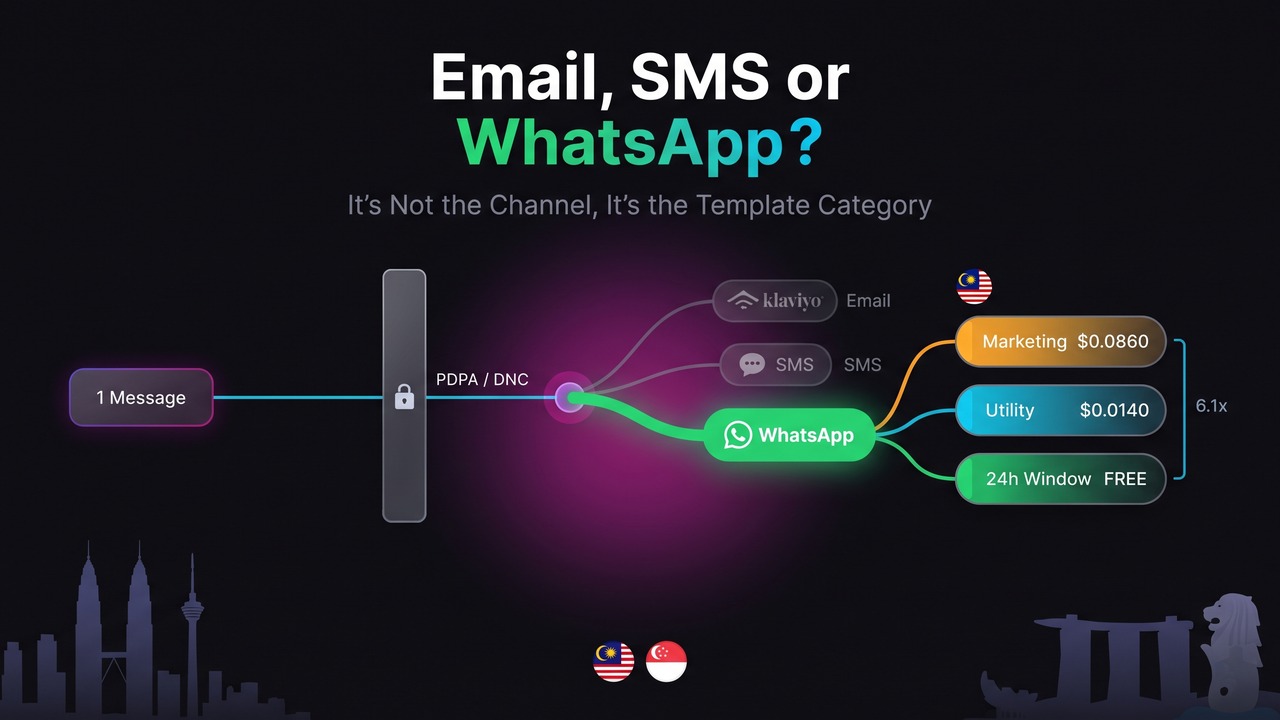
WhatsApp is now a native Klaviyo channel, not a Twilio bridge. Worth stating plainly because a lot of existing "Klaviyo + WhatsApp" content is already out of date on this. Klaviyo shipped native WhatsApp support (Marketing, Utility and Service message types, with native reporting and attribution) in its 2025-26 product cycle, confirmed via its own product-launch post and product page. You need a verified WhatsApp Business Account, but you no longer need to bolt on a third-party API to run WhatsApp inside Klaviyo flows alongside email and SMS. For a region where WhatsApp is the default messaging app for most consumers, that's a bigger structural shift than most brands running Klaviyo have registered yet.
How do you handle PDPA consent across Singapore and Malaysia in one Klaviyo account?
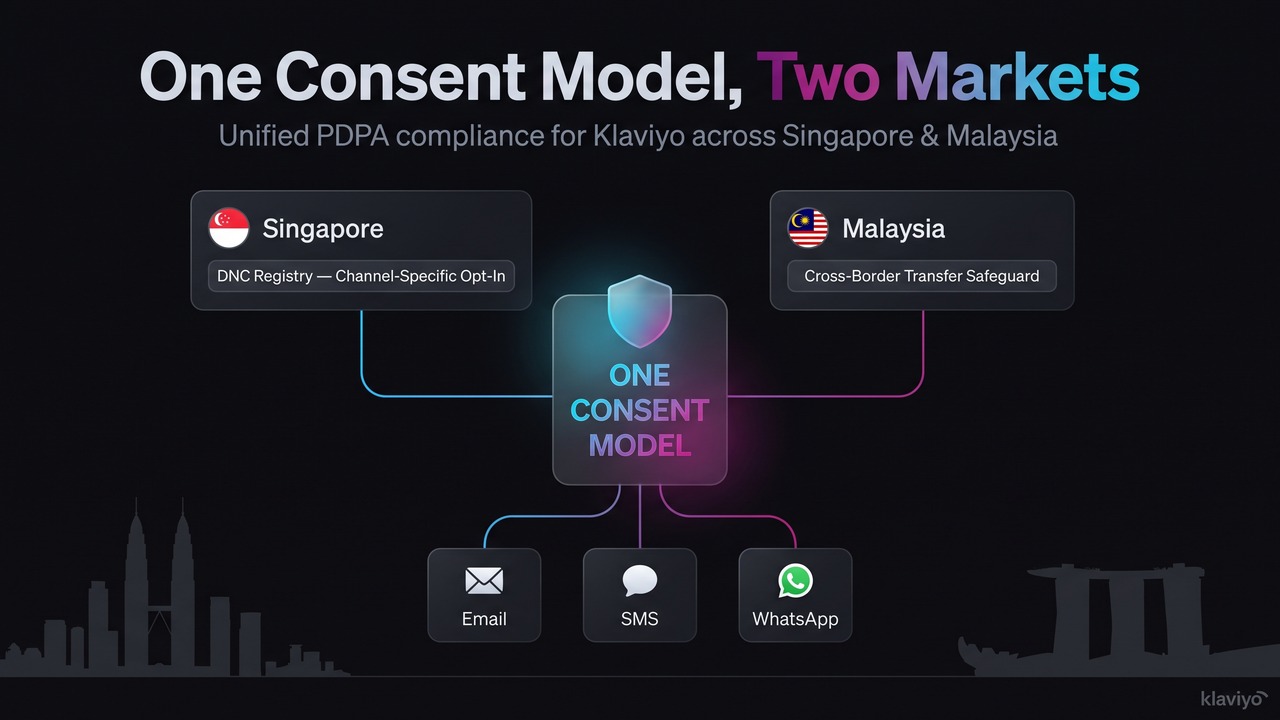
Singapore. Promotional WhatsApp and SMS messages fall under "specified messages" in the Do Not Call (DNC) Registry provisions of the PDPA. That means explicit, channel-specific consent is required before you send them, and you can't message a DNC-registered number without an applicable exemption, typically an existing business relationship where an opt-out was offered. General marketing consent on its own doesn't cover this. (This framing is corroborated by a Singapore marketing-compliance resource, not a law firm or the PDPC itself, so treat it as practitioner interpretation rather than statute.)
Malaysia. No DNC registry equivalent, but the PDPA 2010 requires a written notice of processing purpose and consent for marketing use. Because Klaviyo, like most CDPs, processes data outside Malaysia, cross-border data-transfer safeguards also apply: a comparable protection standard, consent, or contractual safeguards covering the transfer.
| Singapore | Malaysia | |
|---|---|---|
| Registry mechanism | DNC Registry | None |
| Consent trigger | Explicit, channel-specific opt-in for WhatsApp/SMS | Written notice + marketing consent |
| Cross-border requirement | Not the primary concern | Safeguards required (data processed outside Malaysia) |
| Practical fix | Channel-specific opt-in, documented | Notice + consent + transfer safeguard on file |
If you're running one Klaviyo account across both markets, don't build two consent models. Standardise on the stricter regime: explicit, channel-specific opt-in for email, SMS and WhatsApp, a clear per-channel opt-out, and a documented consent timestamp and source for every subscriber. It's simpler to audit and it satisfies both regimes at once instead of running parallel logic in the same account.
Worth saying directly: this is practitioner-sourced guidance, not law-firm-verified legal advice. Confirm your specific consent architecture with counsel before finalising it, particularly the cross-border transfer mechanism for Malaysia.
How should APAC seasonality change your Klaviyo flow calendar?
Western flow guides are built around a Black Friday-to-Christmas calendar. APAC DTC brands in Malaysia and Singapore have a longer, more distributed list to plan around:
- Chinese New Year – gifting-driven; plan welcome-series offers and win-back suppression windows around it, not through it.
- Ramadan and Hari Raya Aidilfitri – a weeks-long lead-up followed by a hard demand spike at Raya itself; abandoned-cart timing should account for slower browse-to-buy during fasting hours.
- Deepavali – a shorter but sharp gifting window, similar planning logic to CNY.
- 9.9, 10.10, 11.11, 12.12 – the regional mega-sale calendar; campaign volume spikes here, so flows, abandoned cart especially, need higher send-frequency tolerance without tipping into fatigue.
- Black Friday/Cyber Monday – still relevant for cross-border MY/SG brands selling into US audiences, layered on top of the MY/SG calendar above, not instead of it.
None of this replaces the standing flow stack. It's a calendar layer on top of it, and it's the part most global Klaviyo guides skip entirely because they aren't written for this region.
How does this tie back to owning your direct revenue, not just running flows?
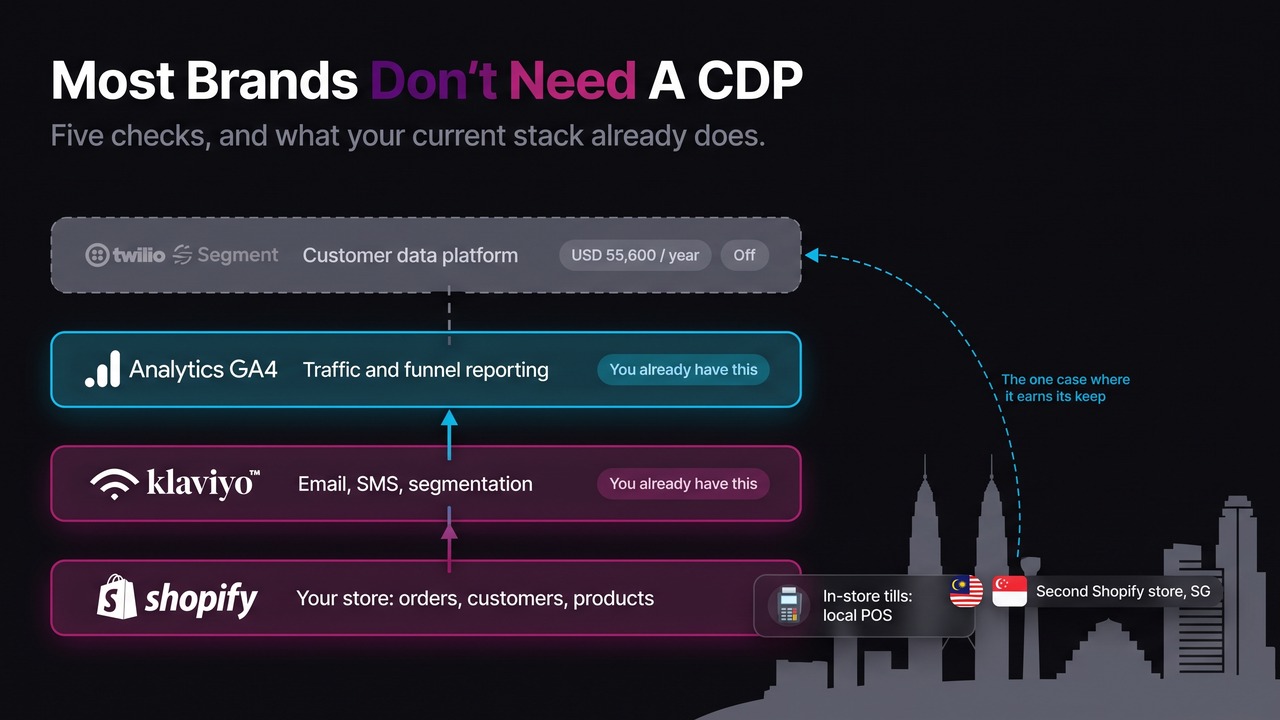
Flows aren't the point. What they protect is the relationship that makes brand.com defensible against Shopee and other marketplaces. A marketplace sale is a transaction; a repeat WhatsApp or email relationship, built on a consent architecture that also unifies your customer data, is captured lifetime value a marketplace never gives you access to. That's the argument for running CDP and CRM under one team instead of treating retention as a bolt-on to paid media: the consent layer and the full-funnel data governance across your stack are the same infrastructure question, not two separate projects.
Frequently Asked Questions
What's the best Klaviyo flow to build first for a Malaysia or Singapore DTC brand?
Abandoned cart, on RPR and placed-order-rate grounds: Klaviyo's own benchmark data shows it averaging $3.65 RPR and a 3.33% placed-order rate, both the highest of any single flow. Welcome is a close second since it captures new-subscriber intent while it's at its highest.
Does Klaviyo support WhatsApp natively now?
Yes, as of its 2025-26 product cycle. Marketing, Utility and Service message types are supported natively, with native reporting and attribution, no Twilio-style bridge required. You do need a verified WhatsApp Business Account to turn it on.
Do Singapore and Malaysia need different consent setups in the same Klaviyo account?
The mechanism differs (Singapore's DNC Registry rules versus Malaysia's cross-border data-transfer safeguards), but the practical fix is the same: one unified, stricter opt-in model covering email, SMS and WhatsApp, rather than two parallel consent systems in one account.
How much revenue does an abandoned cart flow actually recover?
Klaviyo's own numbers are the ones to cite: $3.65 average RPR ($28.89 for the top 10% of brands) and a 3.33% placed-order rate (7.69% for the top 10%). The widely-repeated "20-25% cart recovery" figure comes from third-party marketing blogs, not Klaviyo, and measures something different, so it isn't directly comparable.
How many emails should a Klaviyo welcome series have?
Three, over roughly a week, is Klaviyo's own safe-default recommendation. Extend to five over 7-10 days once you have enough content and offer depth to sustain the extra sends without them feeling like padding.
Flow mechanics, benchmarks and welcome/abandoned-cart/post-purchase structure are well-covered ground globally. The part that isn't: a single consent architecture that satisfies Singapore's DNC rules and Malaysia's cross-border requirements at once, built on a channel mix that now includes native WhatsApp. That's the audit worth running before you touch flow copy.
We're a Klaviyo Gold Partner for Malaysia and Singapore. Want your Klaviyo flows built for both markets at once? Talk to us.