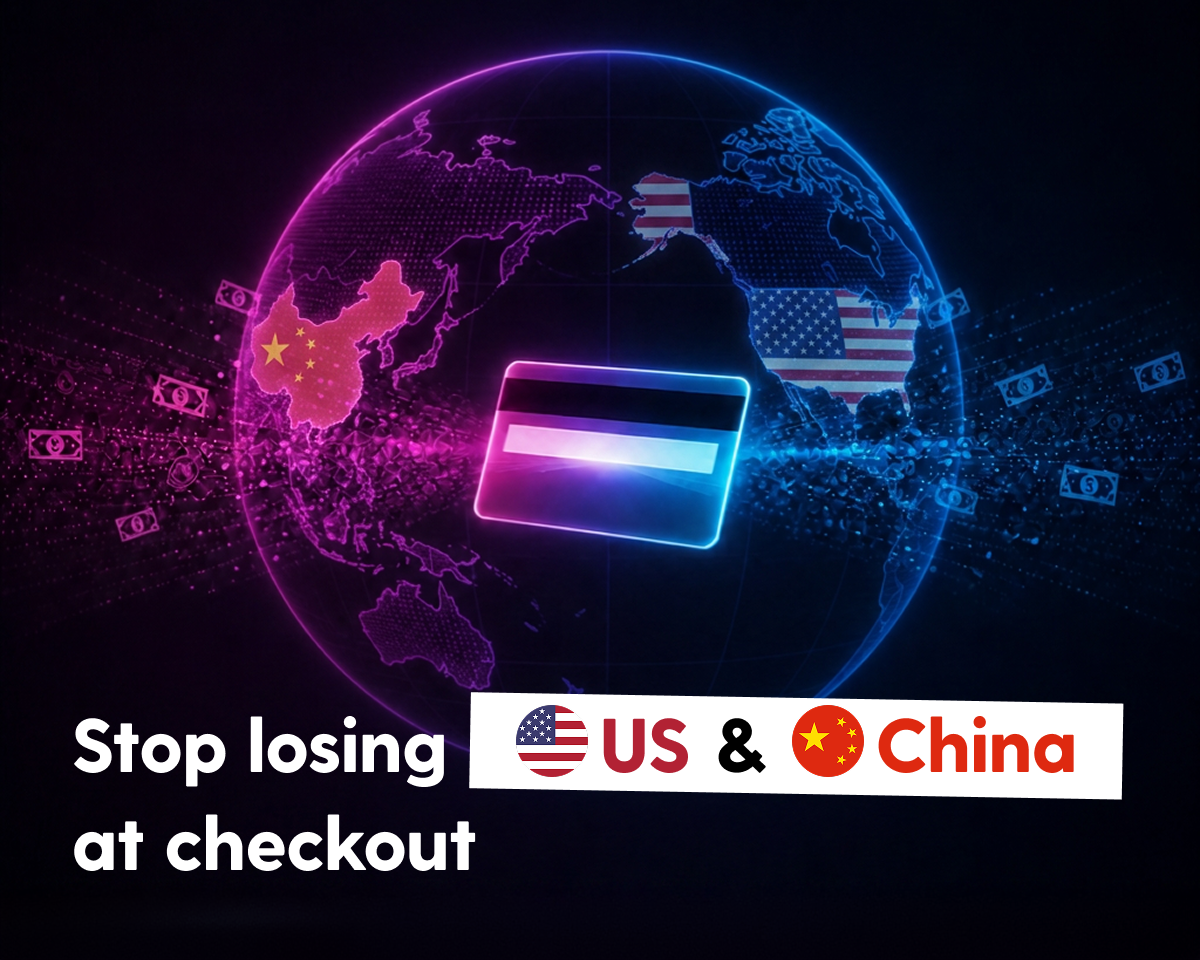
To sell cross-border from Malaysia or Singapore into the US and China, optimise your Shopify checkout around five things, tuned separately for each market: localised payment methods (cards, PayPal and buy-now-pay-later for the US; Alipay, WeChat Pay and UnionPay for China), pricing shown in the buyer's own currency (USD and RMB), a fully transparent landed cost with duties handled on a DDP basis so nothing is charged at the door, market-specific trust signals, and honest delivery-time estimates. Get these right and you attack the biggest documented reasons people abandon carts. The US and China want almost opposite things at the point of payment, so one generic international checkout will quietly lose you both.
Why do international shoppers abandon carts more than domestic ones?
Cart abandonment is brutal even at home. Baymard Institute puts the average documented online cart abandonment rate at 70.22%, based on 50 separate studies. Of the shoppers who abandon at checkout for a fixable reason, 39% leave because extra costs (shipping, tax, fees) are too high, 21% because delivery is too slow, 19% because they do not trust the site with their card details, another 19% because they are forced to create an account, and 10% because there are not enough payment methods. Regionally, APAC records the highest abandonment of any region in Dynamic Yield's benchmark, at roughly 81%.
Cross-border transactions make every one of those reasons worse. The shopper is buying from a brand they may never have heard of, in a currency that is not theirs, from a country they cannot easily return an item to, with duties they cannot predict. The single concept that ties this together is landed cost: the total a customer actually pays to receive the order, which is the product price plus shipping plus duties plus taxes plus any import fees (Passport). When that number is hidden until the last step, or worse, arrives as a bill from the courier days later, the sale is gone and often so is the customer.
The five levers below are where a MY/SG brand recovers that revenue. Treat them as a per-market checklist, not a one-time setup.
What payment methods should you offer US vs China buyers?
Offer US buyers cards, PayPal and BNPL. Offer China buyers Alipay, WeChat Pay and UnionPay. If you only wire up international Visa and Mastercard, you will convert reasonably in the US and almost not at all in China. This is not a minor tweak: merchants who embed local payment methods directly into the checkout have seen up to three times the conversion of an international card-only checkout (PagSeguro).
The US payment stack
US shoppers lead with cards. In the Federal Reserve's Diary of Consumer Payment Choice, credit cards account for around 35% of payments by number and debit around 30%. On top of that, PayPal carries real weight: it lets a shopper pay without handing card details to an unfamiliar foreign site, which directly answers the 19% who abandon over card-security worries. Buy-now-pay-later (Affirm, Afterpay, Klarna, Shop Pay Installments) has become a normal part of US checkout, and it matters more for cross-border because your all-in landed cost is higher than a domestic equivalent. Letting a US buyer spread a higher basket over instalments softens the sticker.
Practically, run this through Shopify Payments plus compatible gateways so cards, PayPal and BNPL sit in one flow, and keep guest checkout on. Forcing account creation alone accounts for 19% of abandonment.
The China payment stack
China is a different planet, and this is where most SEA brands lose the plot. Digital wallets are used by roughly 88% of the population, and Chinese shoppers will abandon at checkout the moment they see no Chinese payment method is accepted. Alipay was used by about 93% and WeChat Pay by about 86% of surveyed Chinese consumers at least once in the prior 12 months, while UnionPay handles around 93% of domestic card transactions (Fabrick).
The flow is also different. Chinese buyers expect to pick a wallet, see the amount in RMB, and confirm with a QR scan or biometrics, not type a 16-digit card number into a Western form. Shopify does not support these wallets natively in every configuration, so you integrate them through a payment service provider that specialises in Chinese methods. Getting this wrong is not a minor conversion tax, it is the difference between a working China channel and none. One caution: accepting Chinese payment methods carries compliance and data-handling obligations, so choose a provider that stays current with local regulation rather than the cheapest integration.
| US buyers | China buyers | |
|---|---|---|
| Primary methods | Cards (Visa, Mastercard, Amex, Discover), PayPal | Alipay, WeChat Pay |
| Secondary | BNPL (Affirm, Afterpay, Klarna, Shop Pay Installments) | UnionPay (card-based) |
| Currency shown | USD | RMB (CNY) |
| Expected flow | Card form or PayPal, guest checkout | Wallet select, QR scan or in-app confirm |
| Deal-breaker | No PayPal, forced account creation | No local wallet accepted (instant abandon) |
How do you show prices in USD and RMB on Shopify without killing your margin?
Use Shopify Markets to set a currency per market, then protect your margin with the conversion fee and rounding settings rather than guessing. Shopify Markets lets you show USD to US buyers and RMB to Chinese buyers, converting from your MYR or SGD base (Shopify).
Two numbers matter for a MY/SG-based store. First, the automatic conversion fee is baked into the customer-facing price, and it is 1.5% for stores based in the US, UK or EEA but 2% for other regions, which includes Malaysia and Singapore. Second, the customer price is calculated as base price multiplied by exchange rate multiplied by (1 plus the conversion fee). If you use manual rates instead of automatic, set the rate to absorb that fee yourself.
To configure it cleanly:
- Create individual markets for the United States and China in Shopify admin. A single-country market defaults to that country's currency (USD, RMB), which you can override if needed.
- Decide automatic vs manual rates. Automatic tracks the FX market but makes your price points wobble; manual holds a stable price you can put in ad creative, as long as you fold the 2% fee into the rate.
- Turn on rounding so conversions land on clean price points ($29.00, not $28.63). Awkward decimals read as "foreign" and undermine trust.
- Add a percentage price uplift per market if you need to cover conversion fee, higher shipping and duties, then test it against local competitors.
The rule underneath all of this: the price a buyer saw in your ad must match the price at checkout. If someone clicks a $29 ad and lands on $31.47 because of raw FX conversion, they read it as a hidden fee, which is the exact anxiety that drives cross-border abandonment.
How do you display landed cost and duties so buyers don't rage-quit at checkout?
Calculate the full landed cost and collect duties at checkout on a DDP basis, so the buyer pays one all-in price and owes nothing on delivery. Surprise duties collected by the courier at the door are one of the fastest ways to turn a completed sale into a refused parcel and a refund.
DDP vs DDU
The two shipping models decide who pays import duties and taxes, and when.
| DDP (Delivered Duty Paid) | DDU / DAP (Delivered Duty Unpaid) | |
|---|---|---|
| Who pays duties/taxes | Merchant collects at checkout, prepays customs | Buyer pays courier or customs on delivery |
| What the buyer sees | One all-in total, nothing at the door | Product + shipping now, a second bill later |
| Experience | Feels like a domestic order | Surprise charge, risk of refusal |
| Best for | Established markets: US, China | Low-volume test markets, with explicit warning |
For both the US and China, DDP is the right default. It mirrors the seamless experience these buyers are trained on, and it removes the doorstep shock that causes refused deliveries. DDU only makes sense for a market you are still testing at low volume, and only if you state plainly at checkout that duties will be due on delivery (Swap Commerce).
Doing it on Shopify
Shopify's Duties and Import Taxes feature calculates duties at checkout using each product's HS code and country of origin, then tags the order as DDP so fulfilment uses the right label. It runs on the Advanced and Plus plans, needs Shopify Payments, and needs every SKU to carry an HS code and country of origin (Shopify).
If you would rather not build customs and tax infrastructure in-house, Managed Markets guarantees the duty and tax amount shown at checkout (Shopify absorbs the difference if customs charges more), guarantees the currency conversion rate on refunds made within 30 days, and provides fraud chargeback protection in certain markets such as the US. For a scaling brand without a compliance team, that trade of margin for predictability is usually worth it.
Whichever path you pick, itemise the checkout: product, shipping, duties and taxes as separate lines, with a clear note that duties are prepaid and nothing more is owed on delivery. Transparency here converts the cost into a trust signal instead of a nasty surprise.
What trust signals actually matter for US vs Chinese buyers?
Trust is market-specific. A US buyer and a Chinese buyer are reassured by completely different cues, and copying one market's playbook into the other leaves money on the table.
US buyers respond to familiar security and payment cues: HTTPS, recognisable card and PayPal logos near the pay button, and a plainly written returns and refund policy that says who pays return shipping and in which currency refunds land. Since 19% abandon over card-security fear, those logos are doing real work.
Chinese buyers have been trained by Tmall and JD.com to expect a vouched-for, seamless experience. On a standalone Shopify store they lose that platform guarantee, so you rebuild it directly: Simplified Chinese throughout (professionally translated, not machine output), RMB pricing, the Alipay and WeChat Pay logos visible at checkout, and explicit DDP reassurance that no customs bill is coming. Supporting the local wallets is itself a trust signal, because it tells the buyer you are properly integrated into their payment ecosystem.
One cue matters in both markets and especially for a PDPA-conscious audience: be explicit about how you handle personal and payment data. A short, honest line on data handling near the payment step lowers perceived risk far more than a generic badge does.
Both markets are mobile-first, so none of this survives a slow or clunky checkout. Compress assets, cut unnecessary redirects between Shopify and the payment page, keep form fields minimal, and place trust cues at the decision points rather than burying them. A checkout that lags reads as unprofessional, and unprofessional reads as unsafe.
How fast do US and China buyers expect delivery, and how do you set expectations at checkout?
US shoppers now expect home delivery in around 3.5 days on average, roughly two days faster than in 2012 (AlixPartners). You are not going to match that shipping from Kuala Lumpur, and pretending otherwise is worse than being slow. Compete on honesty instead: show a realistic delivery window and shipping tiers up-front, so the buyer chooses with full information. Baymard's 21% who abandon over slow delivery are mostly reacting to uncertainty and mismatch, not to a specific number of days.
Logistics design is the lever that actually shrinks transit time. Where you hold stock decides the delivery window: a nearshore stock pool (for example Hong Kong for China-bound orders) minimises transit, while fulfilling everything from one distant pool stretches delivery to one or two weeks (Pattern). As US or China volume grows, a regional 3PL or stock pool closer to the market is often the single biggest delivery-time improvement available, and it feeds straight back into the delivery promise you can make at checkout.
Frequently Asked Questions
Why do international shoppers abandon carts more than local ones?
The same reasons that drive domestic abandonment (extra costs, slow delivery, low trust, missing payment methods) all get amplified cross-border, and new ones appear: currency confusion, unfamiliar payment options, and duties that surface late or arrive as a courier bill. Baymard finds 39% of checkout abandonment is down to extra costs being too high and 10% to too few payment methods, both of which hit harder in cross-border checkouts.
Do I need Shopify Plus to sell cross-border into the US and China?
Not necessarily. Shopify Markets and multi-currency work across plans, but the Duties and Import Taxes at checkout feature runs on the Advanced and Plus plans and requires Shopify Payments. If you want guaranteed duty amounts and FX-locked refunds without building your own compliance stack, Managed Markets adds that. The plan you need depends on how much duty and tax automation you want, not on cross-border access itself.
Should I use DDP or DDU for US and China orders?
Use DDP for both. It shows the buyer one all-in price and prevents the surprise customs charge that causes refused parcels and refunds. DDU is only sensible for a low-volume market you are still testing, and only if you state clearly at checkout that duties will be collected on delivery.
How do I accept Alipay and WeChat Pay on a Shopify store?
Through a payment service provider or gateway that specialises in Chinese methods, since Shopify does not support these wallets natively in every configuration. Show prices in RMB, display the Alipay and WeChat Pay logos at checkout, and keep the flow wallet-first (QR or in-app confirm) rather than forcing a card form.
What currency should I show US and China buyers?
USD for US buyers and RMB for China buyers, set per market in Shopify Markets. Showing local currency removes the currency-confusion driver of abandonment, but remember the 2% conversion fee for MY/SG-based stores is baked into the displayed price, so account for it in your pricing.
Where to start
Do not rebuild everything at once. Start with the market where you already spend on ads, and fix the checkout in this order: get the local payment methods live, switch pricing to the buyer's currency, then move duties to DDP so the landed cost is honest and complete. That sequence removes the biggest abandonment drivers first.
If you are already paying to send US or China traffic to a checkout that leaks, that is a conversion problem, not a traffic problem. As a Shopify Plus Partner working with MY and SG brands, Convx runs CRO and technical Shopify audits that find exactly where a cross-border checkout is bleeding revenue. If you want a second set of eyes on your Shopify build and payment setup, talk to us.