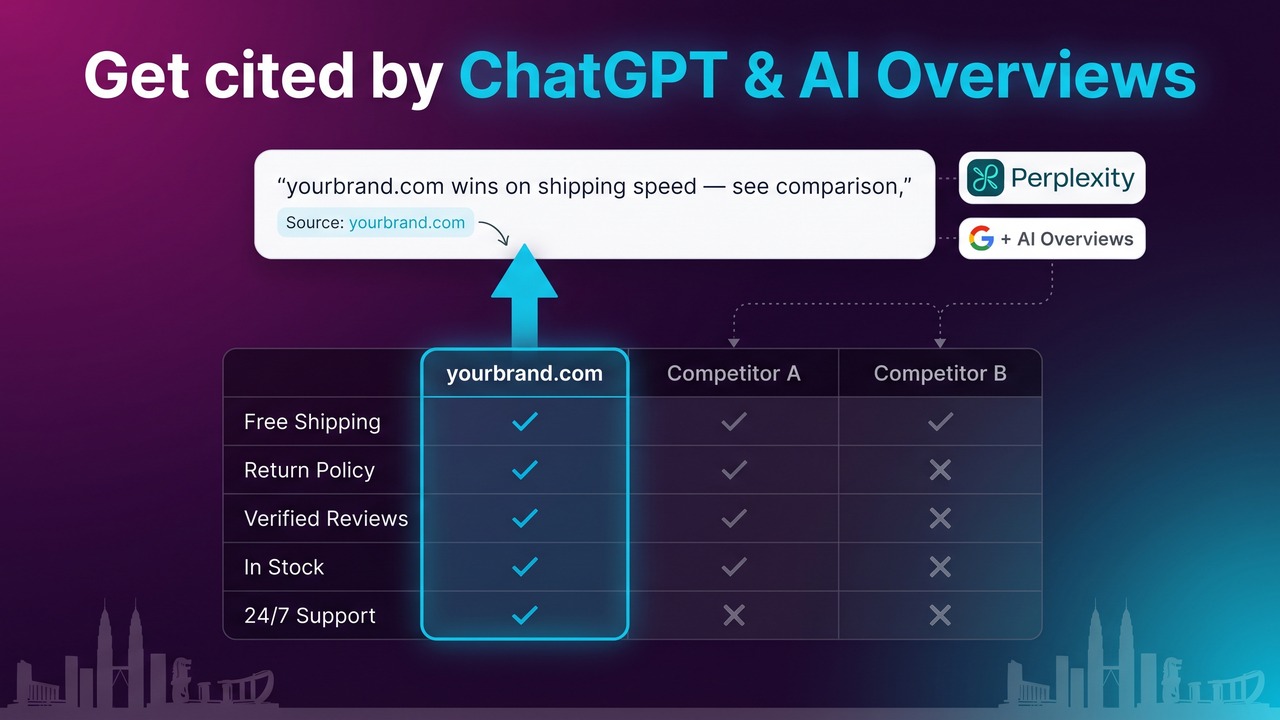
To get your ecommerce brand cited by ChatGPT, Perplexity and Google AI Overviews, you have to become a source these engines can read cleanly and trust enough to quote. In practice that means four things done together: publish genuinely useful comparison and category content that answers the questions buyers actually ask, mark it up with accurate JSON-LD schema (Product, Organization, Review, FAQPage) so machines can extract your facts, make your brand a clear entity in Google's Knowledge Graph, and make sure the search and AI crawlers can index you on both Google and Bing. This is answer engine optimisation (AEO), and it is a different job from ranking blue links. It sends far less traffic than classic search today, but the traffic it does send converts several times better, which is exactly why a scaling DTC brand should start now rather than wait.
What is answer engine optimisation, and how is it different from SEO?
Answer engine optimisation is the practice of shaping your content, data and brand signals so AI answer engines can crawl, understand, trust and quote you inside the answer they generate. Traditional SEO fights to rank a page so a person clicks it. AEO fights to be the source an AI cites while it answers the question directly, often without any click at all. The two overlap, but they are not the same job.
Where this matters for ecommerce is the research phase, not the checkout. AI Overviews show up heavily on comparison and problem-solution queries ("best air purifier for haze", "what to look for in running shoes") and stay out of the way on direct product and transactional searches. In US data, pure ecommerce queries trigger an AI Overview only around 2 to 4% of the time, while informational queries trigger them far more often. So AEO is about owning the questions buyers ask before they are ready to buy, then making sure the page that gets cited is one that can also sell.
This is a separate discipline from using AI to improve your conversion rate once a visitor lands. We have written about that side separately in how AI can strengthen conversion rate optimisation. That post is about conversion. This one is about discovery: being found and recommended in the first place.
Is AI search actually worth optimising for yet?
Yes, but be honest about the shape of it. AI search is a high-intent, low-volume channel. AI platforms are still roughly 1% of total web traffic, and AI engines send around 96% less traffic than Google for comparable queries. If you are chasing raw sessions, this is not where they are.
The reason to care is quality and trajectory. AI referral visits convert at roughly 4.4 times the rate of traditional organic traffic, and for retail sites specifically, ChatGPT-referred traffic has been measured converting at 11.4% versus 5.3% for Google organic to the same sites, because the AI pre-qualifies the visitor before sending them over. On volume, AI platforms generated about 1.13 billion referral visits in June 2025, up 357% year on year. Small base, steep curve.
At the same time, classic search is leaking clicks. Zero-click behaviour is now the majority of Google usage, and in Singapore one 2026 study put it at 69% of queries, up from 56% in a year, rising near 93% when Google's AI Mode is active. Ahrefs found position-one click-through rate falling by more than half when an AI Overview is present. Being cited inside the answer is starting to matter more than ranking under it.
One caveat: the platform-wide figures come from named trackers, but the ecommerce and MY/SG cuts are directional, drawn from small samples and mixed methods (Malaysia's AI Overview presence swung between roughly 6% and 25% across 2025). Treat them as direction, not precision. The direction is clear enough to act on.
How do ChatGPT, Perplexity and Google AI Overviews choose which brands to cite?
Each engine has a different taste in sources, so a single tactic will not cover all three. This is the most misunderstood part of AEO.
EngineWhat it favours for shopping queriesWhat that means for youChatGPT (with search)Retailer and brand product pages, marketplace listings. Retailers are around 36% of cited domains.Make product pages complete, accurate and well marked-up. Keep a clean marketplace presence.Google AI OverviewsUser-generated and editorial content: YouTube, Reddit, Quora, review sites. Retailers only around 4% of sources.Own the comparison guides, seed real reviews, earn editorial coverage and video.PerplexityCommunity discussion plus verifiable sources, Reddit-heavy, with explicit citations.Be present and credible in community threads and back it with documented content on-site.
Two findings from the citation research put this in perspective. Rank still helps: Ahrefs found 76.1% of URLs cited in AI Overviews also rank in Google's top 10. But rank is not enough on its own, and the gap is brutal for brands. MissionMedia's APAC analysis found brand-controlled properties made up only about 47% of AI Overview sources, and more than 73% of brands that rank on Google's first page had zero mentions in AI answers. Ranking well and being cited are now two separate outcomes, and most brands have only earned the first.
What structured data should an ecommerce store add for AI search?
Add JSON-LD schema, because it stopped being a display nicety and became a discovery signal. In March 2025 both Google and Microsoft confirmed they use schema markup to power their generative AI features, and ChatGPT confirmed it uses structured data to decide which products appear in its answers. It is how you hand an AI your facts (price, availability, rating, brand) instead of making it guess.
For a Shopify DTC store in Malaysia or Singapore, this is the stack that earns its keep:
- Organization on the site, with name, logo, url, sameAs (all your social and profile links) and contactPoint. This is the foundation of your brand entity.
- Product on every product page, with offers (price, priceCurrency set explicitly to SGD or MYR, availability), sku, brand, gtin, plus aggregateRating and review where you have real reviews, and shippingDetails and hasMerchantReturnPolicy where you can expose them.
- BreadcrumbList across category and product pages, so the engine understands how a product sits inside a category.
- Review and aggregateRating, because rating and review signals feed directly into shopping answers and product cards.
- FAQPage on shipping, returns, payment and key product questions. It no longer earns a rich result in Google, but it gives LLMs clean question-answer pairs they can lift and attribute.
Two rules decide whether any of this works. First, attribute-rich beats generic: minimal Product markup gives no real AI advantage, while markup carrying price, specs and ratings drives inclusion. Second, and this is the one people get wrong, your schema must match the visible content on the page. AI systems cross-check the two and quietly distrust a page whose schema claims things the text does not. Schema is necessary but not sufficient. It makes you readable and citable; it does not make thin content worth citing.
This is also the layer most stores get wrong at the theme level, which is why our technical implementation team treats schema, feeds and indexing as part of the build rather than an afterthought.
How do you make your brand a clear entity for AI, not just a page?
AI engines increasingly reason about entities (brands, products, people) rather than URLs. If Google's Knowledge Graph does not recognise your brand as a distinct entity, an AI has to guess who you are, and it often guesses wrong or blends you with a similarly named business.
The fix is deliberate. Write a plain brand entity bio in simple factual statements ("Brand is a skincare label for sensitive skin", "Brand is based in Kuala Lumpur"), then reinforce it with full Organization schema that spells out founders, awards, memberships, social profiles and your Merchant Center link through sameAs. Keep your name, address and details consistent everywhere they appear, because an entity typically needs many consistent touchpoints across the web before Google treats its attributes as fact. Claim your knowledge panel the moment one appears. This work matters more in Malaysia and Singapore, where brand names collide across markets and translate awkwardly, and where a weak entity gets confused with an unrelated business or a marketplace reseller.
Can AI even read and find your store?
None of the above matters if the crawlers cannot reach or index you. Start with crawler hygiene. The AI world runs several bots with different jobs: OpenAI uses GPTBot for training and OAI-SearchBot for search, Perplexity uses PerplexityBot for retrieval, and Google uses Googlebot. If your robots.txt or firewall blocks the search crawlers, you disappear from AI answers regardless of how good your content is. Blocking GPTBot only opts you out of model training, which is a separate decision from search visibility, so make it deliberately rather than by accident.
Then index in two places, not one. Most non-Google AI engines retrieve live results through Bing's search index, so a store that is strong on Google and weak on Bing is invisible to a large share of AI answers. Submit clean XML sitemaps to both, adopt IndexNow so price and stock changes are picked up quickly, and use Bing's URL submission for priority pages. Nothing gets cited if it is not indexed, and freshness matters for a catalogue that changes. One more trap: do not hide core product copy, specs or answers behind client-side JavaScript, because many AI crawlers do not execute it and will simply not see that content.
A newer option worth knowing is llms.txt, a proposed Markdown file at your site root that maps your most useful content for LLMs. It is cheap to add and sensible to try, but adoption is uneven and it is not yet load-bearing, so do not treat it as a substitute for the fundamentals above.
What content actually gets cited?
Content that says something useful. Category pages with real descriptive copy get cited far more often than thin pages that jump straight to a product grid, because, as the research bluntly puts it, engines do not cite pages that do not say anything. Quality beats volume here: a site with a few thousand genuinely useful pages will out-cite a site with tens of thousands of thin ones.
The highest-value assets are honest buying and comparison guides that answer the research-phase questions where AI Overviews live: "best X for Y", "what to look for in X", "X versus Z". Build them on something an AI cannot cheaply rewrite, such as your own product testing, customer data or category expertise, and structure them to be quotable. That means question-style headings, self-contained answers that make sense lifted out of context, and tables for comparisons so a machine can read attributes cleanly.
If this post reads like a worked example, that is the point. The answer-first opening, question-shaped headings, comparison table and FAQ schema are all AEO applied to our own blog. We would rather recommend it after eating our own dog food.
Frequently Asked Questions
What is answer engine optimisation (AEO)?
AEO is optimising your content, structured data and brand signals so AI answer engines like ChatGPT, Perplexity and Google AI Overviews can read, trust and cite you inside the answer they generate. It sits on top of SEO: traditional SEO tries to win a click to your page, while AEO tries to make your brand the source the AI quotes, often when no click happens at all.
Does schema markup help my brand get cited by ChatGPT and AI Overviews?
Yes. Since March 2025, Google, Microsoft and OpenAI have confirmed they use structured data to power generative AI features and to decide which products appear. Use accurate JSON-LD (Product, Organization, Review, FAQPage), keep it attribute-rich, and make sure it matches the visible content, because AI systems cross-check the two. Schema is necessary but not sufficient: it makes you citable, but the content still has to be worth citing.
Is AI search traffic worth chasing if it is only about 1% of visits?
For a DTC brand, yes. The volume is small but growing more than 300% year on year, and the quality is high: AI referral visits convert at around 4.4 times traditional organic, and ChatGPT-referred traffic to retail sites has been measured near 11% versus around 5% for Google organic. For a higher-AOV brand, even a small number of these visits is material, and an early foothold is cheaper to build now than to claw back later.
How do I get cited by Reddit-heavy engines like Google AI Overviews and Perplexity?
Your own site is not enough for these engines on shopping queries. They lean on community and user-generated content, so you need a genuine presence where buyers discuss your category: helpful Reddit and Quora contributions, real reviews, YouTube comparisons, and coverage on editorial review sites the engines already trust.
Should I block or allow AI crawlers like GPTBot?
Allow the search crawlers (OAI-SearchBot, PerplexityBot and Googlebot) or you remove yourself from AI answers entirely. Blocking GPTBot is a separate decision: it only opts you out of OpenAI model training, not out of ChatGPT's search answers, so decide it on data-policy grounds rather than assuming it protects visibility.
Where to start
Do not try to do all of this at once. Start with the layer you already control and work outward. First, fix the plumbing: confirm the search crawlers can reach you, index cleanly on both Google and Bing, and get core content out of client-side JavaScript. Second, get your schema right: accurate, attribute-rich JSON-LD that matches your pages, plus a clear Organization entity. Third, earn the content: build the comparison and category pages that answer real buyer questions, then support them with reviews and community presence. That sequence puts the cheapest, highest-certainty work first.
If your Shopify store is ranking but absent from AI answers, that is a visibility problem you can fix with structure, not more ad spend. As a Shopify Plus Partner working with brands across Malaysia and Singapore, Convx builds the technical AEO layer (schema, feeds, indexing and entity setup) and makes sure the high-intent traffic it earns actually converts once it lands. If you want a read on where your store stands, talk to us.
{"@context": "https://schema.org", "@type": "FAQPage", "mainEntity": [{"@type": "Question", "name": "What is answer engine optimisation (AEO)?", "acceptedAnswer": {"@type": "Answer", "text": "AEO is optimising your content, structured data and brand signals so AI answer engines like ChatGPT, Perplexity and Google AI Overviews can read, trust and cite you inside the answer they generate. It sits on top of SEO: traditional SEO tries to win a click to your page, while AEO tries to make your brand the source the AI quotes, often when no click happens at all."}}, {"@type": "Question", "name": "Does schema markup help my brand get cited by ChatGPT and AI Overviews?", "acceptedAnswer": {"@type": "Answer", "text": "Yes. Since March 2025, Google, Microsoft and OpenAI have confirmed they use structured data to power generative AI features and to decide which products appear. Use accurate JSON-LD (Product, Organization, Review, FAQPage), keep it attribute-rich, and make sure it matches the visible content, because AI systems cross-check the two. Schema is necessary but not sufficient: it makes you citable, but the content still has to be worth citing."}}, {"@type": "Question", "name": "Is AI search traffic worth chasing if it is only about 1% of visits?", "acceptedAnswer": {"@type": "Answer", "text": "For a DTC brand, yes. The volume is small but growing more than 300% year on year, and the quality is high: AI referral visits convert at around 4.4 times traditional organic, and ChatGPT-referred traffic to retail sites has been measured near 11% versus around 5% for Google organic. For a higher-AOV brand, even a small number of these visits is material, and an early foothold is cheaper to build now than to claw back later."}}, {"@type": "Question", "name": "How do I get cited by Reddit-heavy engines like Google AI Overviews and Perplexity?", "acceptedAnswer": {"@type": "Answer", "text": "Your own site is not enough for these engines on shopping queries. They lean on community and user-generated content, so you need a genuine presence where buyers discuss your category: helpful Reddit and Quora contributions, real reviews, YouTube comparisons, and coverage on editorial review sites the engines already trust."}}, {"@type": "Question", "name": "Should I block or allow AI crawlers like GPTBot?", "acceptedAnswer": {"@type": "Answer", "text": "Allow the search crawlers (OAI-SearchBot, PerplexityBot and Googlebot) or you remove yourself from AI answers entirely. Blocking GPTBot is a separate decision: it only opts you out of OpenAI model training, not out of ChatGPT's search answers, so decide it on data-policy grounds rather than assuming it protects visibility."}}]}